
Criminal Court Cases in Union County
Union County felony and misdemeanor prosecutions are filed in the Circuit Court. Illinois does not split these matters between county and district trial courts. Traffic cases and municipal ordinance prosecutions can also reach the circuit docket. Police in Anna, Jonesboro, or Cobden may create an incident report, but that report is not the court case. Once the State’s Attorney files a charge, the Union County Circuit Clerk maintains the judicial record.
Union County belongs to Illinois’s First Judicial Circuit with eight other southern counties. Circuit administration is based in Marion, yet it is not the local records counter. Case questions belong with the Union County clerk in Jonesboro. That distinction saves a call to the wrong office and keeps a request tied to the public body that actually holds the file.
Union County's Room 101 Counter
The official Illinois circuit-clerk directory lists Circuit Clerk Keri Clark at 309 W. Market Street, Room 101, Jonesboro, IL 62952. Call 618-833-5913; fax service is available at 618-833-5223. The counter is the direct route for docket sheets, charging instruments, judgments, sentencing orders, and certified dispositions.
Union County Circuit Clerk
309 W. Market Street, Room 101
Jonesboro, IL 62952
618-833-5913
Fax: 618-833-5223
Call before mailing payment because the state directory does not publish current Union County copy, certification, archival, or search fees. Give the full case number when known, the party name, an approximate year, and the exact document needed.
Union County Case Record Searches
Judici’s participating-court list is the practical online starting point. It is a private vendor index used by many downstate courts, not a judiciary-operated statewide database. Coverage, document images, and historical depth can differ. Use it to identify a likely case, then use the clerk when an official or certified record matters.
- Open the participating-court list and confirm Union County is available before entering search terms.
- Search by a known case number first. Otherwise use the full party name and compare identifiers carefully.
- Check the case type, filing year, and status so a person with a similar name is not mistaken for the subject.
- Read filed counts, docket events, disposition, and sentence together. A closed status alone does not show the result.
- Ask the Circuit Clerk for plain or certified copies of the precise entries needed.
| Field Label | Type | Required | Notes |
|---|---|---|---|
| Case number | Text | No | Best match when copied from a notice or prior filing |
| Party name | Text | No | Use full legal spelling and inspect similar-name results |
| County | Court selection | Yes | Confirm Union County participation and coverage |
| Case type | Filter | No | Separates criminal, traffic, and other files when offered |
| Filing year | Date filter | No | Useful when a common name returns several matters |
Judici Is an Index, Not Proof
The Judici court list shows the participating-court route used to start many Union County searches.
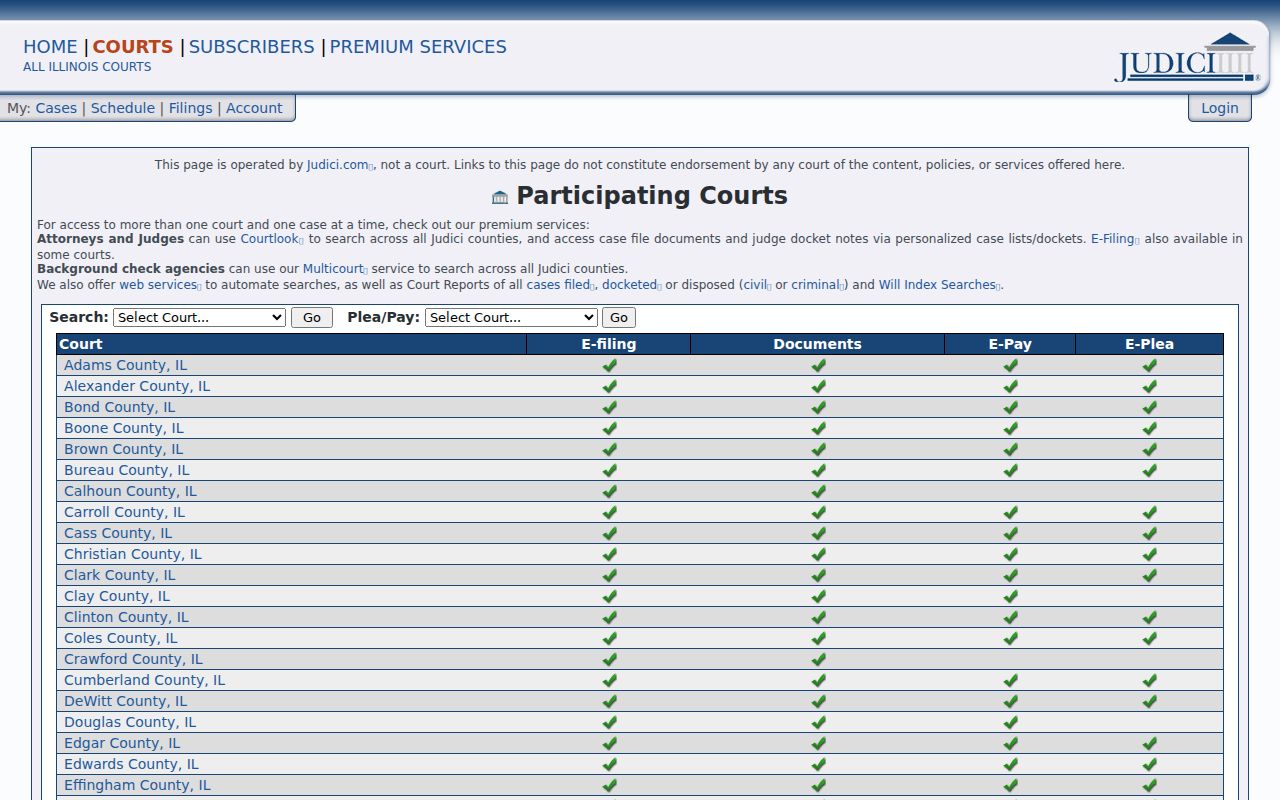
The screen helps locate a docket, but an online omission does not prove that no case exists. Ask Room 101 about paper, archived, restricted, or non-imaged material.
What a Criminal Case File Contains
A useful review follows the charge from filing through outcome. Compare the filed count with the disposition because a prosecutor may amend, dismiss, or decline a booking charge. The docket is a chronological register, not a narrative police report. It records hearings, filings, appearances, orders, and the result entered by the court.
| Case Number & Court | Identifies the Union County proceeding and filing division. |
|---|---|
| Charging Document | Shows the complaint, information, or indictment and cited statutes. |
| Docket Entries | Lists filings, appearances, motions, and orders by date. |
| Hearing Dates | Shows scheduled and completed court events. |
| Disposition & Judgment | States how each count ended, such as conviction, dismissal, or acquittal. |
| Sentence & Conditions | Records custody, probation, supervision, fines, costs, or other terms when imposed. |
Verify Union County Clerk Details
The Illinois Courts clerk directory is the authoritative routing source for local contact details.
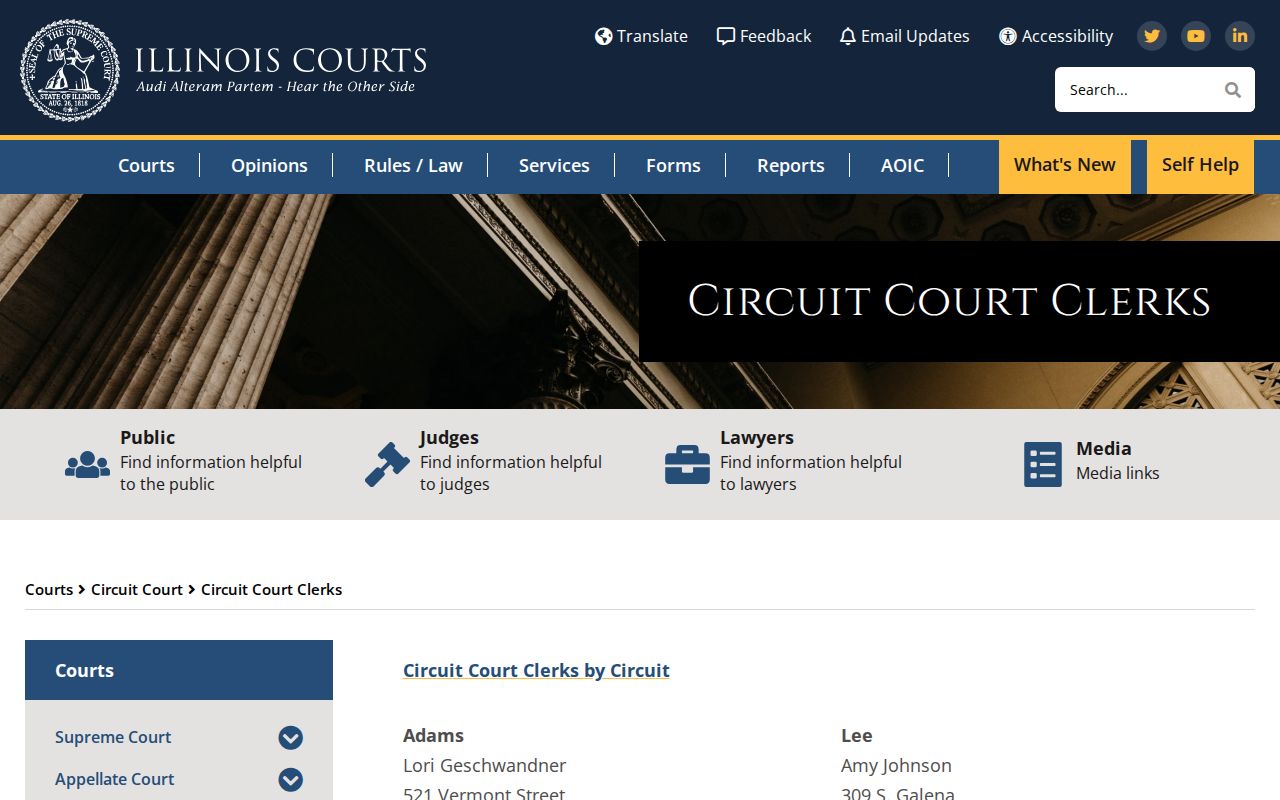
Use the directory contact to confirm copy format, certification, price, and delivery before sending a request or traveling to Jonesboro.
Read Union County Docket Terms
Several short labels can change the meaning of a case search. Read them beside the count and date rather than in isolation.
- Disposition
- The way a charge ended, including conviction, dismissal, or acquittal.
- Nolle prosequi
- A prosecutor’s formal decision not to proceed with a charge at that time.
- Court supervision
- An Illinois outcome that may end in dismissal without a judgment of conviction when completed, but still leaves a record unless cleared.
- Certified disposition
- A clerk-certified record of the court’s final action, often more useful than a portal summary.
Criminal Case Stages in Union County
The arresting agency first creates its own record. The Union County State’s Attorney then makes a filing decision, and the clerk opens the court case when charges are filed. Current Illinois pretrial law governs the initial appearance and release decision. Discovery, motions, hearings, a negotiated plea or trial, and sentencing follow as applicable. No fixed local duration should be inferred because timing depends on the charge, motions, discovery, and court schedule.
Case flow: Charges Filed › Arraignment › Pretrial › Plea or Trial › Disposition › Sentencing
Police Reports Versus Union Court Files
An Anna, Jonesboro, Cobden, sheriff, or ISP report describes the investigating agency’s event. The Union County judicial file shows what prosecutors filed and what the court did. One cannot substitute for the other. A booking allegation may never become a court count, and the ultimate conviction may differ from the charge shown at arrest.
For a complete reconstruction, request the incident report from the originating agency, then match it to the Circuit Clerk case number. If the final court outcome appears wrong in an Illinois repository record, a person reviewing their own record can use ISP Access and Review and the free Record Challenge process with a certified disposition.
Access Rules for Case Records
Illinois court records are generally open, but access has defined limits. Juvenile matters, sealed or expunged files, protected victim information, and private identity data may be withheld or redacted. Illinois Supreme Court Rule 138 protects specified personal identifiers in public filings. An online view may also omit images available at the counter.
The Illinois Freedom of Information Act does not override a sealing order or court confidentiality rule. Ask the clerk whether a missing matter is public, archived, paper-only, sealed, or expunged. Older Union County material may require archival routing rather than an ordinary online search.
Access point: A no-result screen is not a legal finding that a Union County case never existed.
When requesting a Union County file, distinguish a plain copy from a certified copy. A plain copy may be enough for personal study or to understand the sequence of docket events. A certified disposition bears the clerk’s certification and is the stronger document when another official office needs proof of the result. Ask whether the desired item is a docket sheet, complaint, information, indictment, judgment, sentencing order, or complete file. A broad request for everything can cost more and take longer than a request tied to named documents.
Illinois FOIA ordinarily gives a public body five business days to respond to a noncommercial request, subject to the statutory extension and exemptions. Court-file access also follows court rules and statutes outside FOIA. If an agency denies a FOIA request, it should identify its legal basis. Review may be available through the Illinois Attorney General’s Public Access Counselor or court action, but that process cannot open a record made confidential by another law.
Older Union County Case Files
Older and non-imaged matters require more detail than a current portal search. Give Room 101 the party’s full name, approximate filing year, case type, and any former case number found in family papers, notices, or an archive index. Ask whether the record remains in the courthouse, has moved to storage, or is available through an archival collection. The Illinois Regional Archives Depository inventory can help with historical Union County government records, but it is not a substitute for the clerk’s current criminal docket.
Historical research also needs careful identity work. Names can be misspelled, initials reused, and dates entered in older formats. Compare residence, age, co-parties, charge, and year. Never merge two people solely because they share a name. For a modern legal need, ask the clerk which surviving document can be certified and whether the archive copy differs from the court’s official record.
When Union Dispositions Lag
Illinois law requires several criminal-justice offices to report specified events to the ISP Bureau of Identification. An arrest cycle is supposed to connect the arrest, prosecutor filing decision, court charge, disposition, and sentence. Gaps still happen when fingerprints were not taken, an old event was never digitized, the prosecutor decision was delayed, or the court result did not match the original arrest identifier.
For a person checking their own history, the fingerprint-based Access and Review route is stronger than a public name match because fingerprints positively associate the person with the repository record. ISP does not charge its processing fee for Access and Review or Record Challenge, though a fingerprint provider may charge for capture. A certified Union County dismissal, acquittal, amended count, or sentencing order is useful evidence when asking ISP to correct incomplete or inaccurate data. Correction is not expungement; it makes the record accurate.